Real-Time Deformability Cytometry

Quantitative mechanical phenotyping of single cells in flow — label-free and high throughput.

Real-time deformability cytometry (RT-DC) measures intrinsic mechanical properties of individual cells by controlled hydrodynamic deformation in microfluidic channels.

Deformability cytometry enables label-free cell analysis and high-throughput mechanical characterization at single-cell resolution.

Measurement Principle

Hydrodynamic cell deformation in microfluidics

Cells suspended in buffer are driven through a microfluidic constriction channel with defined geometry.

Within the narrow region, cells experience controlled shear and extensional stresses, resulting in measurable deformation.

High-speed imaging captures each cell during passage through the analysis zone.

Images are processed in real time to extract quantitative shape descriptors.

  • Defined channel geometry

  • Laminar flow regime

  • Controlled stress distribution

  • High-speed brightfield imaging

  • Real-time image processing

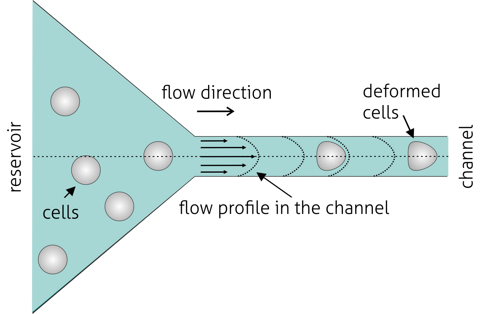
Technical schematic showing cell suspension driven from a reservoir through a defined microfluidic constriction channel, generating laminar flow and controlled stress fields that enable quantitative deformation-based single-cell analysis.

A cell suspension is introduced from a reservoir into a microfluidic channel of defined geometry.

As cells pass through the constricted region, shear and extensional stresses deform the cells in a controlled laminar flow regime, enabling quantitative deformability cytometry.

From Image to Mechanical Parameter

Quantitative mechanical phenotyping of single cells

Each detected cell is segmented from the background and its contour is reconstructed.

From this contour, multiple physical parameters are computed:

  • Cell cross-sectional area

  • Deformation index

  • Aspect ratio

  • Brightfield texture features

  • Derived mechanical descriptors

Mechanical parameters can be mapped to apparent Young’s modulus using numerical models of cell deformation under hydrodynamic stress.

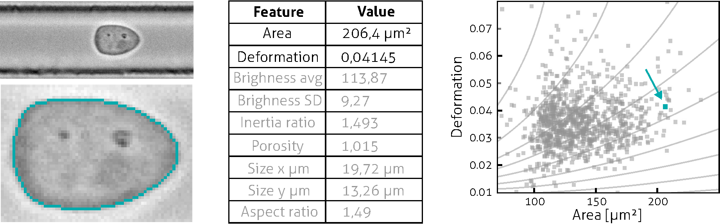
Processing pipeline illustrating how high-speed brightfield images of single cells are segmented to extract quantitative mechanical parameters such as area and deformation, which are mapped into a population-level scatter plot.

High-speed images acquired in the analysis region are segmented in real time to reconstruct the cell contour.
Morphological and mechanical parameters are computed from the extracted shape and visualized as quantitative population distributions.

How RT-DC Compares to Other Cell Mechanics Methods

Established methods for measuring cell mechanical properties — atomic force microscopy (AFM), micropipette aspiration, and optical tweezers — provide high-precision single-cell measurements, but typically at throughputs of one to a few cells per hour. Statistical characterization of heterogeneous populations or rare subpopulations is not practical at this scale.

RT-DC operates at up to 1,000 cells per second. This difference in throughput is not incremental — it changes which biological questions can be asked. Population heterogeneity, activation kinetics, and rare cell identification become accessible without fluorescent markers.

RT-DC does not replace force spectroscopy for applications requiring picoNewton-level precision on adherent cells. It addresses a different regime: suspended cells, large populations, and time-resolved biological processes.

RT-DC and Fluorescence Cytometry: Orthogonal Information

Fluorescence-based cytometry and RT-DC measure different things. FACS identifies cells by what molecular markers they carry. RT-DC quantifies what the cells physically are — their size, deformability, and mechanical state — independent of any labeling.

These two dimensions are orthogonal. RT-DC does not replace fluorescence cytometry; it adds a biophysical layer that fluorescence cannot provide. Both methods can be run on the same samples, and the AcCellerator can be combined with the FluorescenceModule for simultaneous acquisition.

Data and Output

Measurements generate high-dimensional single-cell datasets including:

  • Morphological parameters

  • Mechanical descriptors

  • Population distributions

  • Multivariate scatter plots

  • Exportable raw image data

Data can be analyzed using statistical or machine learning approaches to identify mechanical signatures.

Methodological Foundation

Real-Time Deformability Cytometry was originally introduced in a peer-reviewed publication describing the physical principle, microfluidic implementation, and quantitative image analysis framework of the method.

Since its introduction, the method has been further developed in terms of imaging speed, computational analysis, and integration capabilities.

The foundational description of the technology can be found in:
Otto et al., Nature Methods (2015).

©2026  ZELLMECHANIK DRESDEN