Integrated Fluorescence Detection for Real-Time Deformability Cytometry

FluorescenceModule - Simultaneous fluorescence detection and mechanical phenotyping in flow.

The FluorescenceModule extends real-time deformability cytometry (RT-DC) by enabling synchronized fluorescence detection within the microfluidic measurement channel.

Molecular marker identification and intrinsic mechanical characterization are recorded simultaneously for every single cell — without altering the hydrodynamic measurement conditions.

Molecular Identity Meets Mechanical Phenotype

Fluorescence-based flow cytometry is widely used to identify cell populations via established surface markers. Real-time deformability cytometry enables label-free quantification of intrinsic mechanical properties such as deformation, size, and morphology.

The FluorescenceModule integrates both approaches into a single measurement region, allowing synchronized acquisition of fluorescence intensity and mechanical parameters at high throughput.

This enables:

  • Identification of defined cell populations within heterogeneous samples

  • Direct correlation of fluorescence markers with mechanical phenotype

  • Functional immune profiling without physical pre-sorting

  • Translational mechanophenotyping of blood-derived cells

Optical Principle: Confined Light-Sheet Excitation

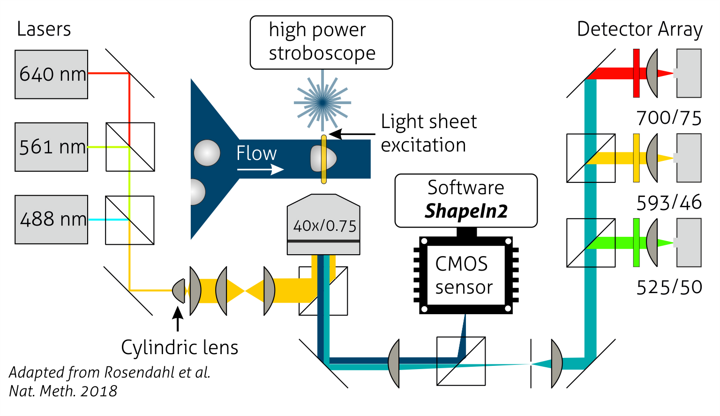
A confined excitation light sheet is projected across the microfluidic channel. Cells pass through a narrow illumination curtain, enabling one-dimensional fluorescence imaging along the flow direction.

The fluorescence signal is detected by a dedicated detector array and synchronized with the RT-DC measurement.

Key characteristics:

  • Up to three excitation lasers (typically 488 nm, 561 nm, 640 nm)

  • Up to three independent detection channels

  • Real-time fluorescence analysis (>100 cells per second)

  • Minimal bleaching outside the excitation zone

  • Temporal resolution down to 0.5 µs for 1D fluorescence imaging

This optical configuration preserves the mechanical measurement integrity while adding molecular specificity.

Optical schematic of the FluorescenceModule showing excitation lasers (488 nm, 561 nm, 640 nm), cylindrical lens for light-sheet generation, microfluidic channel, detector array and CMOS sensor integrated with RT-DC.

Optical configuration of the FluorescenceModule. Excitation lasers are shaped into a confined light sheet across the microfluidic channel. Emitted fluorescence is detected by a multi-channel detector array and synchronized with mechanical measurements in RT-DC.

Published in: Rosendahl et al., Nature Methods (2018) → View publication

Identification of Defined Cell Populations

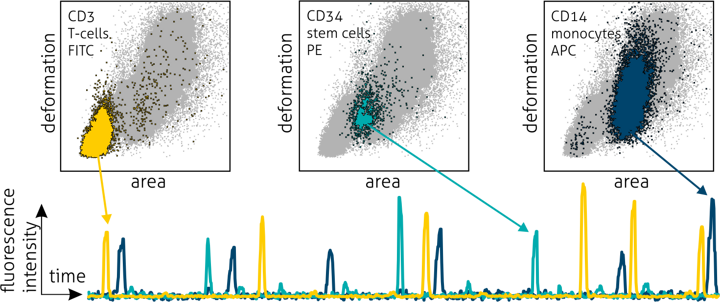
Simultaneous fluorescence detection allows identification of cell types based on established surface markers while mechanical parameters are extracted in parallel.

For each detected event, deformation, size, brightness and fluorescence intensity are stored and analyzed in real time.

This enables:

  • Immune cell profiling without marker-based cell sorting

  • Stem cell characterization with mechanical readout

  • Comparative analysis of mechanical biomarkers across defined subpopulations

Scatter plots of deformation versus cell area with fluorescence-defined subpopulations (CD3, CD34, CD14) and corresponding fluorescence intensity traces recorded during real-time deformability cytometry.

Simultaneous fluorescence detection and mechanical phenotyping. Surface-marker-defined cell populations (e.g., CD3⁺ T-cells, CD34⁺ stem cells, CD14⁺ monocytes) are identified in parallel with deformation and size measurements, enabling direct correlation of molecular identity and mechanical phenotype.

Published in: Rosendahl et al., Nature Methods (2018) Supplementary Figure 5 → View publication

One-Dimensional Fluorescence Imaging of Intracellular Structures

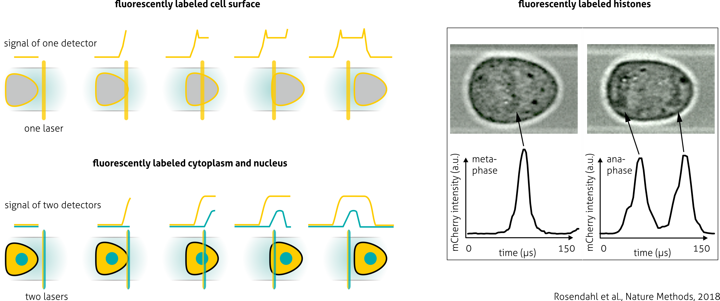
Because fluorescence intensity is recorded as a temporal profile while cells traverse the excitation sheet, the shape of the detected peak reflects the spatial distribution of labeled structures within the cell.

This allows discrimination between:

  • Membrane-localized signals

  • Cytoplasmic labeling

  • Nuclear or chromatin-associated fluorescence

For example, fluorescently labeled histones produce distinct signal patterns depending on cell-cycle stage, enabling correlation of intracellular organization with mechanical phenotype.

The method provides subcellular insight in flow without full 2D fluorescence microscopy.

Schematic illustration of one-dimensional fluorescence imaging in real-time deformability cytometry showing confined light-sheet excitation and temporal fluorescence peak profiles reflecting intracellular structure distribution.

One-dimensional fluorescence imaging in flow. As cells traverse the confined light sheet, the temporal fluorescence signal reflects the spatial distribution of labeled intracellular structures. Narrow or broadened peaks correspond to distinct subcellular localization patterns.

Published in: Rosendahl et al., Nature Methods (2018) Supplementary Figure 8 → View publication

Software Integration and Real-Time Gating

Fluorescence detection is fully integrated into the Shape-In acquisition software.

The system enables:

  • Definition of measurement parameters and acquisition conditions

  • Real-time gating of fluorescence-defined subpopulations

  • Simultaneous storage of image data, deformation parameters and fluorescence signals

  • Direct export of synchronized mechanical and molecular datasets

Subpopulations can be identified and analyzed during acquisition without interrupting the measurement workflow.

Technical Configuration

The FluorescenceModule is configurable according to experimental requirements.

Configuration options include:

  • 1–3 excitation lasers (customer selectable)

  • 1–3 detection channels

  • Laser safety integration compliant with EN 60825-1 (Class 1 system)

  • Upgrade option for existing AcCellerator systems

  • Installation, calibration and user training included

Commercially Available Extension Module

The FluorescenceModule is commercially available as an add-on for the AcCellerator platform or as part of new system configurations.

The price for the highest technical configuration (3 Lasers, 3 Detection channels) is 148 000 €.

(price only for business customers from academia within Europe, excl. VAT)

©2026  ZELLMECHANIK DRESDEN