Automated Whole Blood Mechanical Analysis

AcCellerator Ruby – A Translational Platform for Standardized Blood Cell Phenotyping

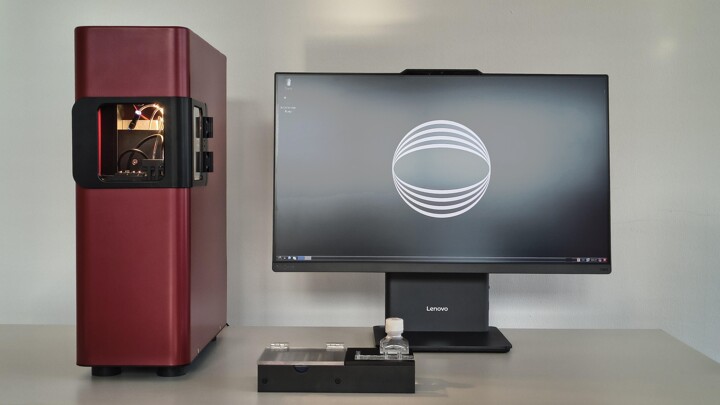
AcCellerator Ruby standalone automated system for label-free mechanical whole blood cell analysis with integrated imaging and microfluidic chip platform.

Ruby enables fully automated, label-free mechanical characterization of whole blood samples under standardized conditions.

Designed for translational and clinical research environments, Ruby minimizes operator dependency while maintaining single-cell resolution and full data transparency.

It translates real-time deformability cytometry into a streamlined, application-oriented platform.

Designed for Translational and Clinical Research

Ruby is developed for laboratories working at the interface of research and medical application.

Key characteristics supporting translational use:

  • Standardized whole blood workflow

  • Minimal manual handling

  • Disposable closed microfluidic chip (RubyC)

  • No instrument contamination

  • Reproducible measurement conditions

  • Quantitative population-level statistics

  • Full single-cell traceability

Ruby enables consistent data generation across operators and laboratories — a prerequisite for future clinical validation studies.

Built for Whole Blood

Ruby is a fully integrated, standalone system for automated mechanical blood cell characterization.

Unlike the modular AcCellerator research platform, Ruby is:

  • A dedicated hematology research instrument

  • Fully automated from sample loading to result output

  • Delivered as a complete, calibrated system

  • Not compatible with AcCellerator add-ons

Ruby reduces technical complexity to a standardized workflow — enabling reproducible blood cell analysis across laboratories.

Fully Automated Workflow with RubyC Microfluidic Chip

Ruby is operated using the dedicated single-use microfluidic chip RubyC, specifically designed for standardized whole blood analysis.

Measurement procedure:

  1. Pipette one drop of whole blood into the designated RubyC inlet

  2. Add two drops of measurement buffer into the corresponding buffer reservoirs

  3. Insert the chip into the Ruby system

  4. Press start

The system automatically performs:

  • Chip initialization and filling

  • Measurement region positioning

  • Autofocus

  • Real-time quality control

  • Population identification and classification

  • Data export

Closed Disposable Microfluidics for Standardized Operation

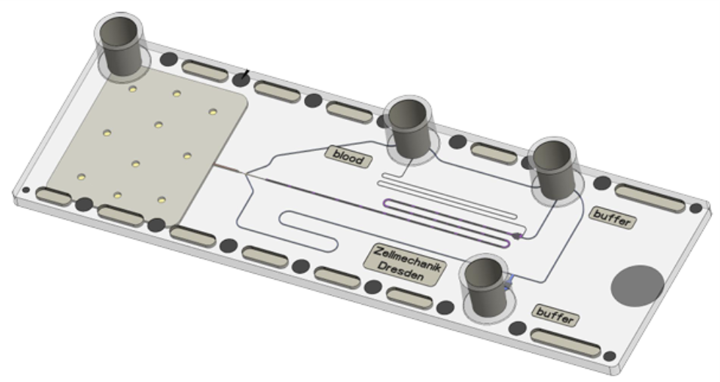
RubyC disposable microfluidic chip with four reservoirs for whole blood sample input, measurement buffer addition, and waste collection used in the Ruby system.

The dedicated RubyC chip contains the entire sample during measurement.
Whole blood never contacts internal instrument components.

This closed workflow:

  • Reduces contamination risk

  • Eliminates cleaning procedures

  • Simplifies multi-sample operation

  • Supports inter-laboratory standardization

After measurement, the chip is safely removed and disposed.

What Ruby Measures

Ruby combines real-time mechanical phenotyping with automated morphological classification.

Key parameters:

  • Cell deformability by cell type (Erythrocytes, Neutrophils, Lymphocytes, Monocytes)

  • Cell size

  • Optical brightness and granularity

  • Morphological parameters from individual cell images

  • Population statistics and single-cell raw data export

Each measured cell is documented by image — enabling artifact detection and full data transparency.

Performance & Throughput

  • ~20,000 RBCs analyzed per measurement

  • ~2,000 WBCs detected and characterized

  • Measurement time: approx. 15 minutes

  • Fully documented single-cell dataset

  • Daily calibration protocols included

Ruby delivers statistically robust results in a clinically relevant timeframe.

Software & Data Transparency

The integrated Ruby software provides:

  • Automated cell type classification

  • Real-time quality monitoring

  • Artifact filtering

  • Population statistics

  • Raw data export

Every measured cell remains traceable.

From Mechanobiology to Application-Driven Blood Analysis

Mechanical blood cell phenotyping has demonstrated sensitivity to changes in cellular state.

Ruby translates this principle into a standardized and automated system designed to generate reproducible datasets suitable for longitudinal and multi-center studies.

It provides a technical foundation for future biomarker development and clinical validation workflows.

Technical Specifications

  • Single-use microfluidic chips

  • Integrated imaging system

  • Controlled pressure-driven flow

  • Fully enclosed and calibrated hardware

  • Delivered as complete standalone unit

Automated Whole Blood Analysis in Action

Screen recording of the Ruby software during a full measurement cycle. After loading 20 µL of whole blood into a single-use microfluidic chip, the system automatically fills the channel, focuses on the measurement region, and begins real-time analysis. Approximately 20 000 erythrocytes (RBCs) are analyzed within seconds, followed by automated detection and characterization of approximately 2 000 leukocytes (WBCs). Continuous quality monitoring ensures reproducible and reliable results.

Pricing

The AcCellerator  Ruby  is 50 000 €. 

(price only for business customers from academia within Europe, excl. VAT)

Any question, suggestion or criticism?
©2026  ZELLMECHANIK DRESDEN